
Essential Hand Tools Every Handyman Needs for DIY Projects
- Ed Hamel
- Jun 9
- 5 min read

Updated: Jun 10
Time to start knocking off some of those DIY projects you been thinking about, but do you have the right tools for the job? If you already have many of the tools pictured below and maybe a few more, you're on your way. You could probably skip this post all together and move onto the next. There are a few tool recommendations worth a look below, however. But if you don't have the basic tools for even the most simple undertaking, read on. You'll be ready to go in no time.


You will find that in the world of DIY, the opionions folks have on tools are no different than opinions you hear on automobile brands, computer hardware and software, smartphones and so on. Everybody has an opinion. But as you gain experience in knocking out DIY projects and build out your tool arsenal you will find what works for you. And after all, that's all that really matters. What you will find below is a solid foundation of basic hand tools that will get you through many do it yourself projects that will pop up. Every one of these tools I listed is available on Amazon. I provided a link above above the photo of each tool that you can click on and be taken directly to the Amazon page. You can have all of these tools in a day or two. That's exciting!
Hammer
A hammer is the most fundamental tool for driving nails, removing them, and light demolition. A claw hammer is the best choice for most DIY projects because it combines a flat striking surface with a curved claw for pulling nails out.
Choose a hammer weighing between 16 and 20 ounces for good control and power.
Look for a comfortable handle with a non-slip grip.
Use the hammer for hanging pictures, assembling furniture, or minor framing.
This could be the last claw hammer you will ever need to buy!

Screwdrivers
Screwdrivers come in many shapes and sizes, but every handyman needs a basic set of flathead and Phillips head screwdrivers.
A medium-sized flathead and Phillips screwdriver cover most household screws.
Consider a set with interchangeable bits for versatility.
Magnetic tips help hold screws in place during installation.
Use screwdrivers for tightening loose cabinet handles, assembling shelves, or fixing electrical outlets.
There are endless options for screwdrivers. This is a great value for a starter set.

Pliers
Pliers come in different types, but a pair of needle-nose pliers and slip-joint pliers are must-haves.
Needle-nose pliers are perfect for gripping small objects and reaching tight spaces.
Slip-joint pliers adjust to grip different sizes and provide strong leverage.
Use pliers for bending wires, holding nails, or removing staples.
When it comes to a set of pliers, this is one of the best values I've found on Amazon. You have everything you need for most projects with the exception of vise grips. I'll get to them next.

Vice Grips
I don't know who the genius was who came up with these things, but if you ask any experienced DIYer about vice grips and if they have any. I guarantee you, they do. Vice grips are life savers when you need to get ahold of something and have your hands free for something else. Getting a set of five for less than $30.00 is a steal.

Socket Ratchet Wrench Set
I'd be remiss if I didn't include adding a socket ratchet wrench set to this list of basic tools. Vice grips, adjustable wrenches and pliers simply cannot take the place of a ratcheting wrench and the right socket. This is a very basic and affordable set in both SAE and metic sizes that you can add accessories to down the road and it even includes hex head wrenches. Bargin!

Open End Wrenches
There will be times that you will not be able to get a ratchet wrench and socket into tight spots or you will need a tool to hold a nut in place while you use a ratchet wrench to loosen a bolt screwed into it. Vice grips can work in this case too, but there might not be enough space. That's where an open end wrench come into the picture and save the day. You can easily pay over $100 for high-end, open end wrenches, but we're building out a what might be your first tool box here. These are a great value for what you're getting. You'll be glad you have them too.

Adjustable Wrench
An adjustable wrench replaces multiple fixed-size wrenches and fits a variety of nuts and bolts.
Choose a wrench with a smooth adjustment mechanism.
A 6 to 8-inch wrench is versatile for plumbing repairs, assembling furniture, and tightening bolts.
Use it to fix leaking pipes, tighten bolts on appliances, or assemble metal frames.
I promise you. It's going to happen. You will have a nut or bolt that for some reason none of your tools will fit. These are indispensible when that happens.

Handsaw
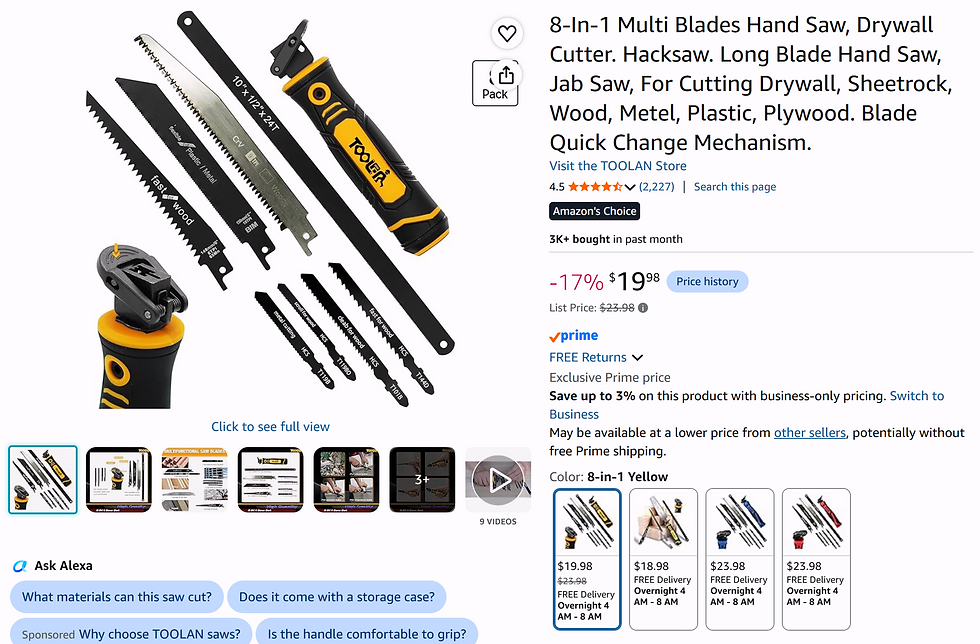
When it comes to saws I'm a bit spoiled. All mine are powered. But if you're starting out and only need the something basic you can't go wrong with this multi blade hand saw on Amazon. You will need to step up to something electric, however, if you're going to take on any sort of remodeling. But this will do in a pinch.
Utility Knife
A sharp utility knife is essential for cutting drywall, opening boxes, trimming materials, and scoring surfaces.
Choose a knife with replaceable blades.
A retractable blade improves safety.
Use it for cutting carpet, trimming wallpaper, or slicing insulation.
I have one of these and I love it. Easy blade replacement and there's storage for extra blades. It's perfect for chopping up all those Amazon boxes. Safety tip! Replace dull blades. A sharp blade glides through what you are cutting without you having to force the knife, slipping and injuring yourself. Replacement blades are inexpensive.

Tape Measure
Accurate measurements are critical for any project. A 25-foot tape measure is ideal for most home tasks.
Look for a tape with a locking mechanism to hold the measurement.
A wide blade with clear markings improves readability.
Use the tape measure for measuring walls, furniture dimensions, or cutting materials to size.
Don't mess around with short tape measures. Anything less than 10 feet is a waste of time, especially if you're taking measurements on walls and for flooring. A tape measure like this is perfect for walls and floors yet still a managable size and weight for smaller projects.

Level
I don't know about you, but I am a fanatic about anything I build or assemble being level and plumb. I have a variety of levels I use in different lengths, but a 12" torpedo is a great place to start. Levels ensure your projects are straight and balanced, which is crucial for shelves, pictures, and furniture assembly.
A 12-inch level is a good size for most tasks.
Look for a level with easy-to-read bubble vials.
Use the level to hang pictures evenly or install cabinets.

Combination Square
While we're on the subject of things being straight, how about square? A combination square helps measure and mark right angles and straight lines.
It includes a ruler and a 90-degree head.
Use it to check corners, mark cut lines, or measure depth.
Essential for woodworking and precise measurements.

Safety Gear
While not a hand tool, safety gear is critical for any DIY project.
Always wear safety glasses to protect your eyes.
Use work gloves to prevent cuts and blisters.
Hearing protection is important when using noisy tools.
I hope this has been helpful for you and fun. In my next post I will cover tool storage. Thank you for stopping in!

Comments